



When educating patients and their parents about myopia management options, a commonly heard phrase is, “If it were my own child, this is the path I would choose for them.” As of last week, I am now that parent with their myopic child in the exam chair, and I am navigating those same options that I speak with parents about every week.
As an orthokeratology (ortho-k) enthusiast, it is certainly on the list as a management option for my 9-year-old daughter. However, there are reports that young patients with low myopic refractive errors using ortho-k lenses have lower amounts of axial length control compared to older kids and higher refractive errors.1
Decrease Optic Zone Size, Increase Myopic Defocus
There is understood to be a dose-response mechanism when using ortho-k lenses for myopia control. Creating myopic defocus in the mid-peripheral retina reduces the stimulus for the axial length to increase.2 More myopic defocus, less axial elongation.
Myopic defocus is created by the corneal reshaping that occurs with ortho-k lens wear. The hydraulic forces under the lens flatten the central cornea and steepen the mid-periphery. This mid-peripheral change is what creates the myopic defocus at the level of the retina.3 On topography, the steepened mid-peripheral appears as a warm colored ring around the pupil.
To reduce the stimulus for axial lengthening, some of that ring must overlap the pupil margin. If a patient’s myopia is progressing despite ortho-k use, the back optical zone diameter (BOZD) can be reduced to shift more of the mid-peripheral steeping into the area of the pupil, creating more myopic defocus (Figure 1).
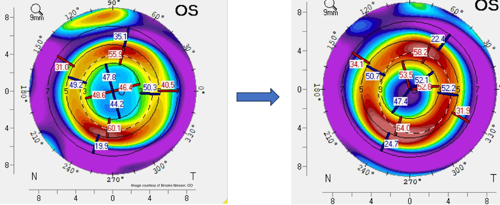
One caveat for this technique in low myopes is the modest amount of steepening generated in the corneal mid-periphery. There is less corneal shape change in low myopes, so a reduced BOZD alone may not generate enough control of a young patient’s myopia.
More Compression, More Control?
Another studied parameter in ortho-k lenses is the compression factor. Also known as the Jessen factor, the compression factor is the amount of corneal curvature change above the amount of myopia being treated. This leaves patients with a slight hyperopic over-correction in the early part of the day so that the myopic correction is sufficient for the entire day. There is mixed evidence reported on whether increasing the compression factor alone can improve control over increasing myopia and axial lengths.2,4,5 There is stronger literature support for higher baseline myopia, smaller BOZD, and larger baseline pupil sizes showing improved myopia control with ortho-k lenses.5,6
Should ortho-k treatment be desired by a young patient with low myopia, it is important to understand that maximizing the management of myopia progression can be complicated in this sub-group. Decreasing the BOZD is a first step, but that alone may not be enough. Further treatment may be needed with low-dose atropine as combination therapy so that the myopia is both controlled and corrected.
References
-
Hu, X., Wang, Z., Sun, B., et al. (2025). Orthokeratology for myopia control: A three-year longitudinal study on axial length modulation influenced by baseline age and spherical equivalent. BMC Ophthalmology, 25, 466.
-
Michaud, L., Gagnon, F., & Simard, P. (2025, February). Orthokeratology principles and design. Review of Contact Lenses.
-
Kang, P., Gifford, P., & Swarbrick, H. (2013). Can manipulation of orthokeratology lens parameters modify peripheral refraction? Optometry and Vision Science, 90, 1237–1248.
-
Tang, W.-T., Zhang, H.-D., Li, S.-B., & Liang, H. (2023). Orthokeratology with increased compression factor in adolescent myopia control: A 2-year prospective randomized clinical trial. International Journal of Ophthalmology, 16, 770–777.
-
Wu, J., Zhang, X., Wang, L., Zhang, P., Guo, X., & Xie, P. (2024). Altering optical zone diameter, reverse curve width, and compression factor: Impacts on visual performance and axial elongation in orthokeratology. Contact Lens and Anterior Eye, 47(3), 102136. doi:10.1016/j.clae.2024.102136. Epub 2024 Mar 19. PMID: 38503665
- Pauné, J., Fonts, S., Rodríguez, L., & Queirós, A. (2021). The role of back optic zone diameter in myopia control with orthokeratology lenses. Journal of Clinical Medicine, 10, 336.

This content is sponsored by Bausch + Lomb